
Sub-Total: $0.00
45 Game/Factors Game
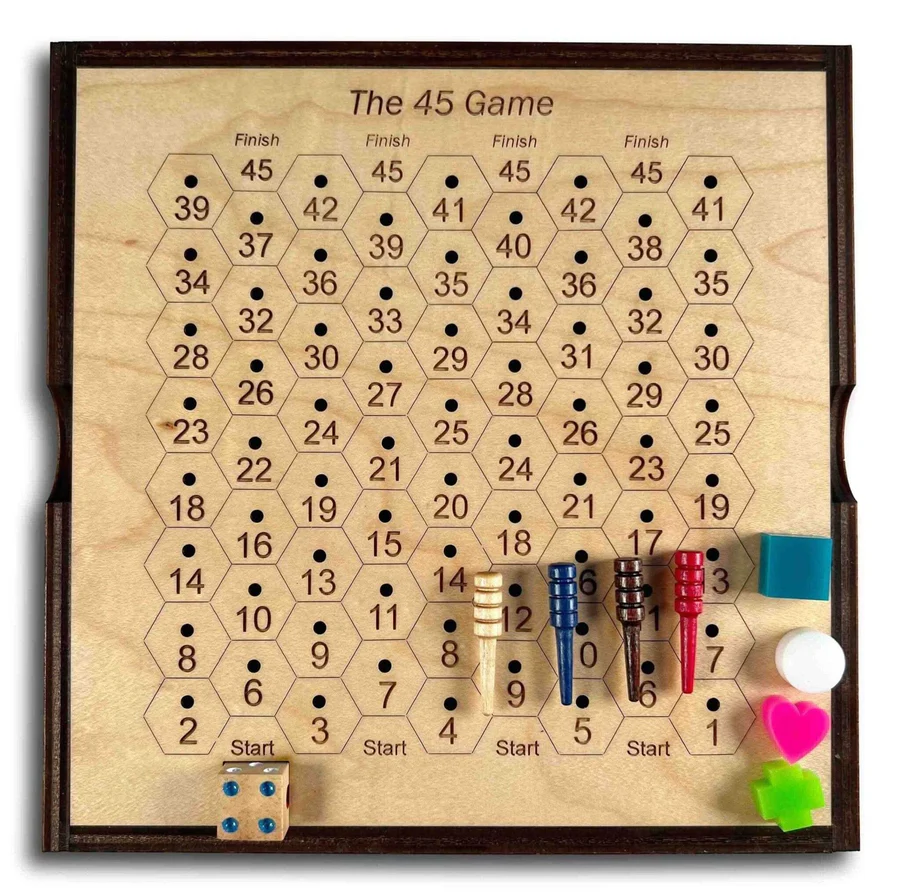
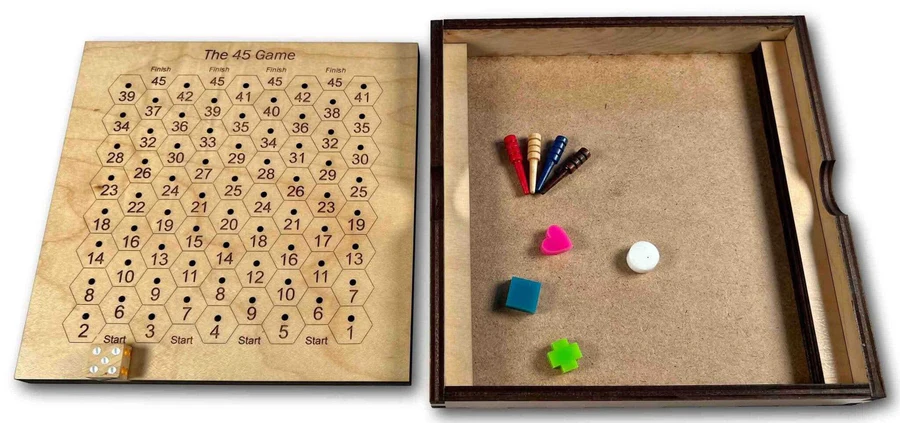
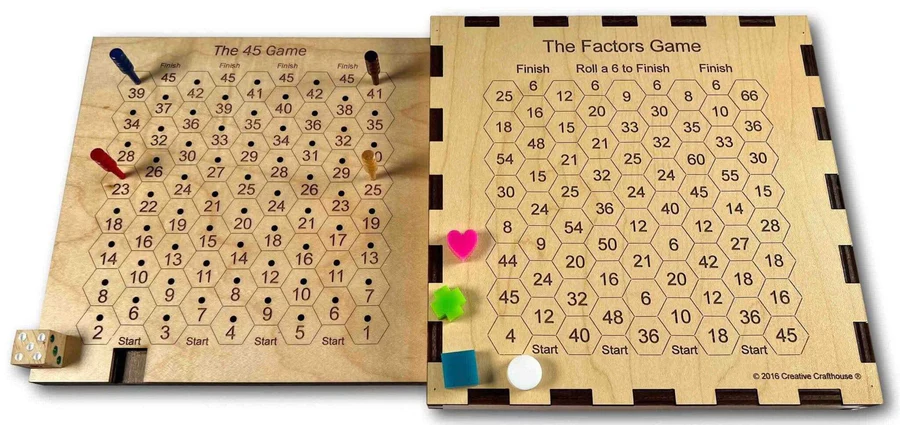
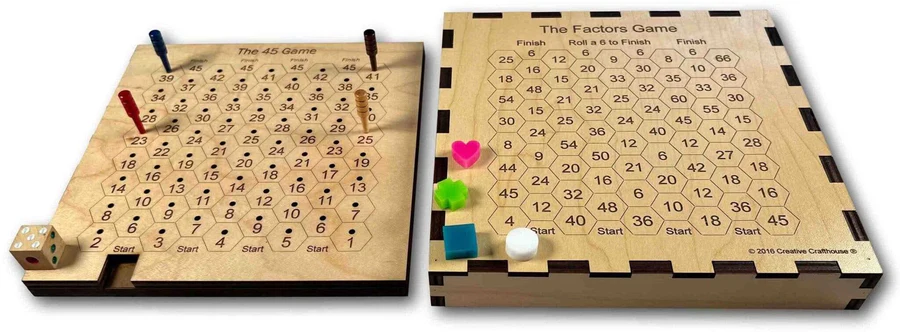
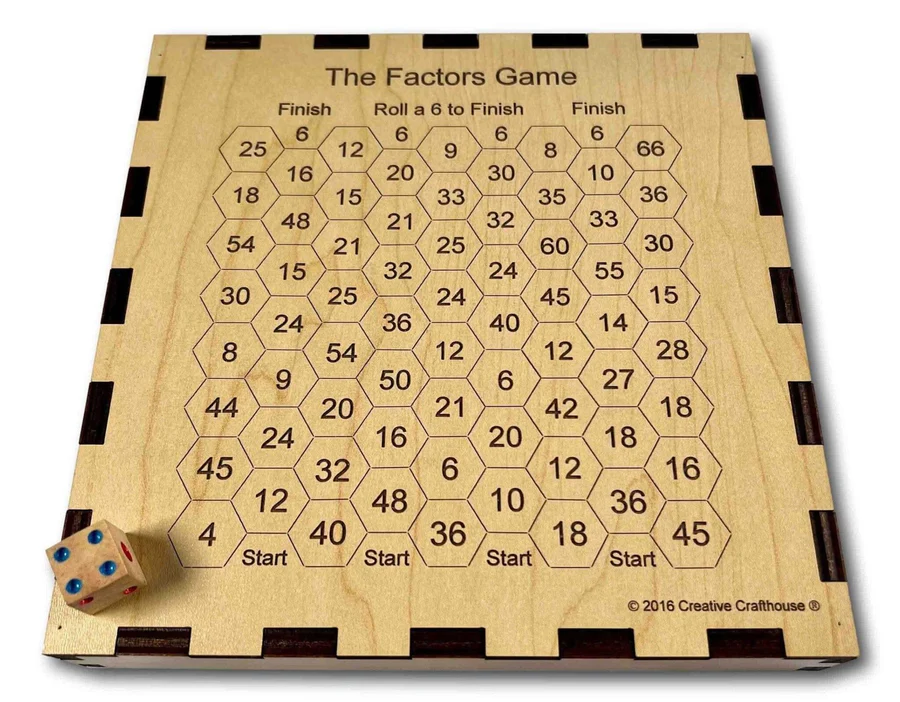
This is two games in one.
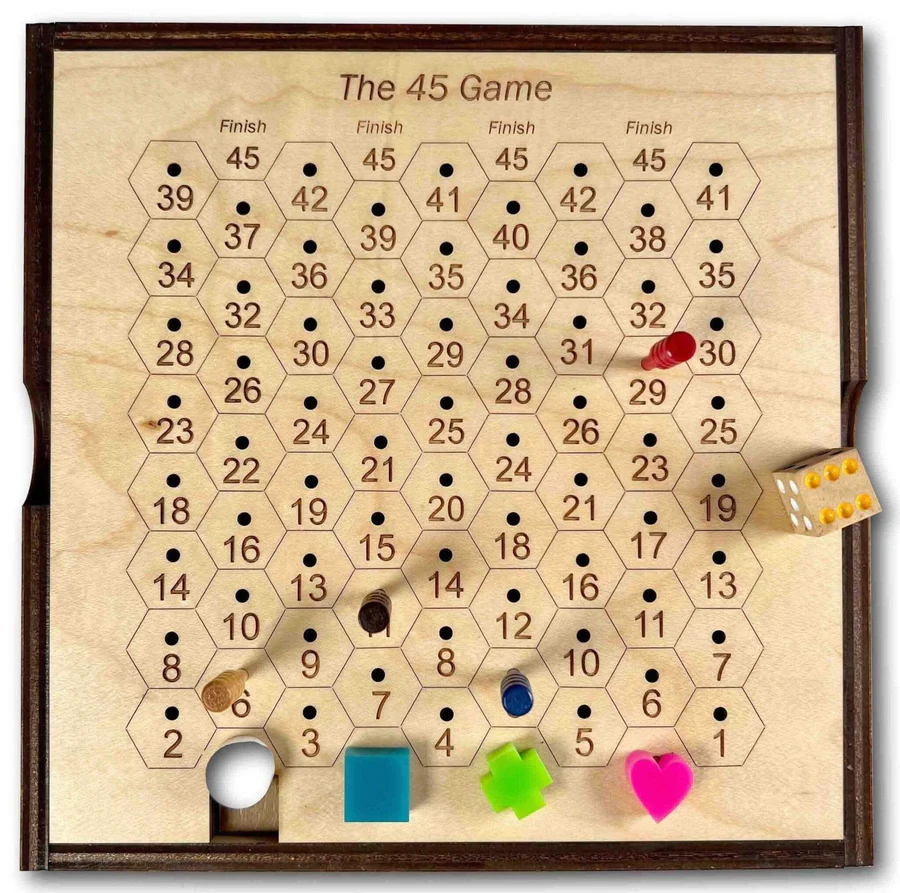
Two to four players take turns rolling a die. If playing the 45 game, the player adds the number on the rolled die to the number their marker is on to see if they can move. If playing the Factors game, the number rolled on the die must be a factor of a number adjacent to the position of their marker be able to move.
More than just fun games, they teach addition and multiplication/division.
See complete rules below.
Thanks to Teresa Evans from MakingMathMoreFun.com for allowing Creative Crafthouse to use these terrific game ideas and covert them to a wood set.
Measures about 7.5” square x 1.5” deep
$35.95
“Add to Cart” Button Down Below▼
The Factors Game Rules
2 to 4 players. Each player selects a colored flat marker as their game piece.
Players take turns rolling the die. On a player’s first turn, the player may move onto the board to a space that is a multiple of the number shown on the die.
For each subsequent turn a player can move one space, but only to an adjacent number that is a multiple of the number shown on the die. For example, if you are on space #5 and you roll a “3”, then you may move to space #9 or space #6 as 3 is a factor of either of these numbers. You could not move to space #10. If you rolled a “4” on the die, you could not move at all as neither 6, 9, or 10 have 4 as a factor.
You may not move to a space occupied by an opponent. If you cannot make a legal move, play passes on to the next person.
The first player to reach 45 at the top is the winner.
Alternate Rule you may opt to play: If you land on an opponent, you send him back to start.
The 45 Game Rules
2 to 4 players. Each player selects a colored peg.
Players take turns rolling the die.
The player may move onto the board to a space that has the number shown on the die.
For each subsequent turn, players take turns rolling the die. They then add the number shown on the die to the number under their marker. If the sum matches the number on an adjoining space, then the player can move to that space. For example, a player on 5 who throws a 2, ( 5+2=7) can’t move as no 7 adjoins the 5 space. A player on 5 who throws 4 (5+4=9) can move to the 9 space.
You may not move to a space already occupied by another player. If you cannot make a legal move, play passes on to the next person.
The first player to reach 45 at the top is the winner.
Alternate rule you may opt to play: If you land on an opponent, you send the opponent back to start.
Related products
-
Safecracker 50
$31.75 Add to cart -
Penny Drop II Dice Game
Price range: $20.95 through $31.75 Select options This product has multiple variants. The options may be chosen on the product page -

Jumbo SafeCracker 40 Puzzle
$199.95 Add to cart -
Sum 15 Game
$15.49 Add to cart